of the site
A Novel Look at Physician Income: Why a medical career is the wrong career if money is one of your primary motives
Analysis by Kevin Pezzi, MD: The cliché about rich doctors is so well-known that it verges on redundancy in the minds of many people. However, I will demonstrate how people in seemingly much less lucrative jobs can outearn doctors. For example, who would think that a UPS driver or auto mechanic could earn more than a doctor? Probably no one except me and, in a few minutes, you, too.
The January 26, 2004 edition of U.S. News & World Report said that UPS drivers earn $60,000 per year (my UPS driver said that he earns $85,000 per year circa 2009). The average physician income is usually quoted as being $160,000 to $200,000 per year, so it may seem preposterous to claim that UPS drivers can earn more than doctors. Just wait.
According to information given to me by a UPS representative on May 13, 2005, UPS drivers require no specialized education. Thus, a person could begin working for UPS immediately after high school. In contrast, a would-be doctor requires many years of education for which he is paid nothing. In fact, doctors typically incur substantial debt to pay for college and medical school. So UPS drivers are being paid while those who aspire to become doctors are paying for the privilege of pursuing their dream.
Let's analyze how this affects their net income. We will begin looking at total net income for physicians at year 8, once they graduate from medical school with an average debt around $100,000. Students may make small amounts of money while in college, but this (and much more) is immediately spent on tuition, fees, books, supplies, and other college expenses. Beer, for instance. :-)
UPDATE (3-16-2015): A commenter said that UPS drivers no longer earn such lavish starting income (though they do indeed still rake in money after what amounts to their internship/residency is over). Since this complicates the analysis, ignore or discount what I wrote about UPS drivers and substitute the equivalent and often much greater income for the occupational alternatives I presented below and in a LinkedIn article: $70,000 per year, start now (that article's title is intentionally understated).
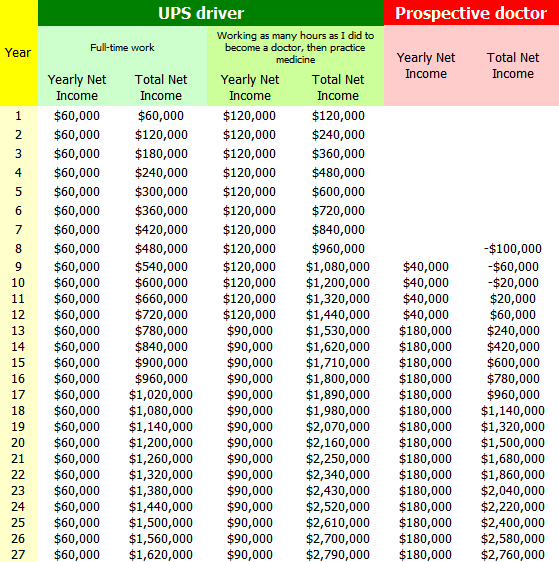
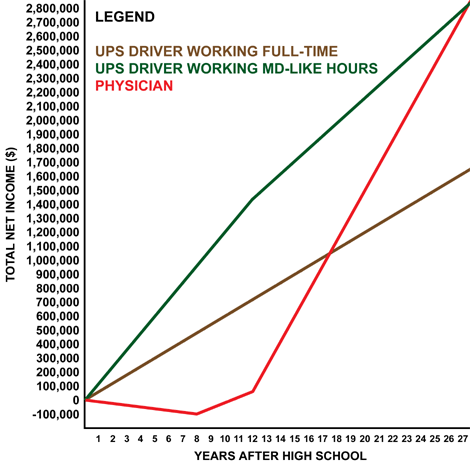
This data indicates that:
- It takes about 18 years for a doctor to approximately equal the lifetime earnings of a UPS driver working full-time.
- It takes about 27 years for a doctor to approximately equal the lifetime earnings of a UPS driver working as many hours as I did to become a doctor, then practice medicine.
In reality, it will take longer for the doc to "catch up" for the following reasons:
- I did not consider the interest that doctors pay on their student loan debts. This interest often leaves doctors with more than their original debt at the end of their residency years. Thus, while they may make $160,000 (total) during a four-year residency, they may leave it with $130,000 of debt.
- I calculated this comparison using a four-year residency program during years 9 through 12. Some residency programs are shorter, but many are longer (thus keeping doctors relatively impoverished for a longer time). Furthermore, many students take longer than eight years to complete college and medical school—and those are the lucky ones who make it. Most students who try to become doctors never succeed, thus incurring debt for a career that never materializes.
- The average doctor salary may not even be $180,000. Some sources pegged it at $160,000.
- Doctors do not earn their average salary the first year they begin working as an attending (year 13 in this example). It typically takes several years for their income to plateau. I began working for less than half (even adjusting for inflation) what I would ultimately earn as my peak income five years later.
- Doctors sometimes must "buy into" the practice they wish to join. They can't just show up and say, "OK, I'm working now, so start paying me." For that privilege, they may have to shell out $100,000 or more, which is sometimes demanded as an up-front fee. Few young doctors have that kind of money, so they usually must borrow it—further increasing their debt.
- Because of their schooling, the earning years for doctors are compressed into a shorter period of time, thus increasing their income tax rates relative to UPS drivers. Translation: Even if the doctor earns the same total amount of money as a UPS driver, the doc's tax rate will be higher, leaving him with less after-tax income.
- Doctors must pay steep licensing fees to state and federal government regulatory agencies. They could also be sued and lose everything they've ever made.
- Students often receive money from relatives and sometimes family friends because they are needy students. UPS drivers, and most other adults, are not similarly showered with such money. This money is rarely reported to the government or included in statistical analyses, so the educational cost is actually higher than you may think.
- The burnout rate for doctors in some specialties is so high that doctors may quit well before age 65. For example, the average longevity for ER doctors is nine years.
- Doctors do not work anything close to a 40-hour week! I worked about 110 hours per week (see * below) during my training. As an attending physician, I averaged about 40 hours per week of paid work and 15 to 20 (or more) hours per week of unpaid but mandatory work, such as working past the end of my shift to "clean up" (complete the care for) patients, do dictations, sign medical records, fill out insurance and other forms, attend various staff and committee meetings, participate in CME (continuing medical education) activities, and on and on. To make this a fair comparison for income potential, we should consider what a UPS driver could make if he worked two shifts (or another job) for years 1 through 12, then a half-time job in addition to his primary UPS job. Therefore, after 12 years such a UPS driver who worked as many hours as I did could have made $1,440,000. After 18 years, the total income would be $1,980,000, easily surpassing the total doctor income. The doctor might catch up after 27 years, if not for the aforementioned factors.
* What about the new 80 hour per week work restrictions for residents? First, it is still equivalent to working two full-time jobs. Second, that is 80 hours per week spent in the hospital. It does not account for the substantial amount of reading that residents must do in their "off hours."
UPS drivers typically do not seem to be as wealthy as doctors because, like just about everyone else, they usually begin spending money as soon as they make it. But what if we made this comparison even more fair, and had the UPS driver live as frugally as the student/doctor for years 1 through 12? If a UPS driver scrimped as I did, he could invest most of his salary, reaping the benefits of many years of compound interest.

Want to earn $1000?
who finds a source that presents
better, easier, safer, and more
pleasant ways to lose weight
than the tips in the current
edition of my FREE weight loss book.
If you are still debating about the financial wisdom of forgoing a doctor's smock for the seemingly plebeian brown UPS uniforms, consider this: Like many other workers, UPS drivers receive a raft of benefits. Many doctors receive nothing but salary (that was the case for almost every job I had as a physician). As an independent contractor, I received no health insurance, dental insurance, optical insurance, unemployment insurance, life insurance, sick pay, overtime pay, personal days, workers' compensation benefits, or pension. Furthermore, I didn't just pay the usual Social Security contribution; I also paid the portion normally contributed by the employer. A state "Small Business" tax further eroded my earnings. And I had to buy my own uniforms and pay someone to embroider my name on them!
See the Comment from a former UPS driver at the end of this page.
UPS drivers are well-paid, but receive less than some other truck drivers. In the December, 2004 Time Inside Business, Bill Zollars, chairman and CEO of Yellow Roadway, the largest trucking firm in the United States, said that his average driver makes $70,000 per year in addition to good benefits.
If maximizing income is your goal, forget about being a truck driver or a doctor. On February 18, 2004, Paul Harvey reported that auto mechanics willing to move to in-demand areas can earn up to $120,000 per year, with employers eager to hire them offering inducements such as paying for their tools and education (some technicians earn two-year certificates or degrees in auto repair, while other receive only high school-level training).
Want more fun and less work?
Want smiles, not stress?
Read Dr. Pezzi's free e-book
Microhome Living

If you want even more money, consider working as a contractor putting in basements. One of my friends, a well-to-do pharmaceutical representative, grumbled how he made less money than his uneducated brother-in-law who worked six months of the year building basements, netting him over $350,000 (adjusted for interim inflation in 2009 dollars). Furthermore, he usually arranged his deals so he was paid in cash, which enabled him to hide most of his income from the IRS.
Perhaps you want a job that is less intellectually demanding than building basements. If so, do what I used to do: mow lawns. At my peak, I earned wages that are now equivalent to $100 per hour. And that was just payment for my own labor. If I were smarter, I would have hired people to work for me, paid them $20 per hour, and kept the rest as profit. I could also build more of my inventions that increase the efficiency of lawn mowing, thus decreasing the time required to mow a yard. Customers pay for getting their lawns mowed, not for how many hours you waste on mowing with antiquated technology.
Noel Molina made $112,000 in 2015 as a garbage truck driver.
Want more examples? According to Forbes magazine (March 15, 2004), Oneida's workers in New York average $30 per hour with benefits. That's $60,000 per year for making eating utensils. Need more dough? In "Confessions of a Personal Trainer" in the July 12, 2004 edition of Newsweek, Mike Torchia said that he makes $150 per hour. That's $300,000 per year for 40-hour workweeks — for helping housewives shed flab! In the ER, I made half that for saving lives and working much longer weeks after an incomparably longer and more intensive education.
 Still more examples? Genital teaching associates make up to $120 per hour for helping medical students learn to perform genital and rectal exams (Details magazine, September, 2004). An advertising copywriter reported in Newsweek magazine that he made up to $100 per hour for inducing people to buy things they did not need. Forbes (June 9, 2003) magazine said that a celebrity chef can make $150,000 per year (some undoubtedly make much more than that) for, I might scornfully add, helping people clog their arteries. According to the February 12, 2007 issue of Forbes, an experienced watchmaker can earn well over $110,000. For tantalizing men, ABC-TV's 20/20 said that strippers can make $2000 per day—about three times what I made in the ER. An episode of CNN’s This is Life with Lisa Ling included a stripper who earned up to $3000 per evening, which is likely about $500 per hour. If she worked as many hours per year as I did to become a doctor, she could make $2.86 MILLION per year! Some strippers gripe about how hard their job is, but learning anatomy is more arduous than revealing it.
A life coach who advertises in a local paper charges $165 per hour. What qualifies her to be a life coach? She claims to have read a book on this subject and taken an online course that anyone with a credit card could sign up for. After this ridiculously short period of "training," she feels that she is somehow worth $165/hour. Perhaps there are life coaches who truly are worth more than doctors who save people's lives (ahem!), but every person I've met who wanted to be a life coach was a woman with a screwed-up life that could serve only as an example of what not to emulate. Other than a credit card and a pulse, the most essential prerequisites for becoming a life coach are an immense ego and endless chutzpah.
If you don't mind doing real work and can tolerate cold weather, you could earn $30,000 to $60,000 working two months of the year as an ice road trucker in northern Canada.
Heavy equipment operators in Alberta, Canada can make $200,000 per year working 12-hour shifts with four days on and five days off. Even unskilled laborers mining those oil sands can take home $80,000 per year, according to the March, 2007 issue of Popular Mechanics magazine.
“Oil rig workers make nearly $100,000 a year,” but highly skilled ones make even more: reservoir engineers earn $139,868, and drilling consultants can make $235,586. A manager “makes about half a million dollars a year.”
Wireline operators start at about $120,000 a year and can earn up to $300,000 annually. NOTE TO THOSE WHO WRITE TO ME COMPLAINING THAT SOME DOCTORS CAN EVENTUALLY EARN MORE THAN UPS DRIVERS: That was just one of the many examples I posted over the years. With certain careers, such as this one that requires no experience, you could make considerably more than physicians and you can rake in piles of cash when you're still young enough to enjoy it! You'll work overtime to make $300K in this job, but all doctors work years of overtime in their training, and often throughout their careers.
I expanded on this topic in a LinkedIn article ($70,000 per year, start now) in which I gave concrete examples of how people can earn hundreds of thousands of dollars per year doing work that's much easier to get than a UPS job. Here's one of them: How One Woman Makes Almost $1 Million A Year On Etsy: “That's about as much as top orthopedic surgeons make, and more than twice as much as the United States president makes.”
Here's another: longshoremen average $147,000 in annual salary with $80,000/year pensions and $35,000/year in employer-paid healthcare benefits. Since it is much easier to become (and be) a longshoreman than a doctor, I could have compared longshoreman-versus-doctor income instead of UPS driver-versus-doctor income. If you do the math, you'll quickly realize that an average longshoreman will earn much more than an average doctor, receive better benefits and pension, and do it all by working considerably fewer hours and much less education, responsibility, and stress.
In the 40,000 hours it takes training to become a licensed doctor, a longshoreman working a comparable number of hours could make about $3 million plus healthcare plus pension worth another fortune—all while doctors are acquiring a mountain of debt without a penny of net income! Bottom line: the average doctor will never catch up, thus proving my point that if money is your goal, you have better options than medical careers.
On December 3, 2013, Chuck Reed, Mayor of San Jose, California, said their yearly cost for a police officer is $200,000, much of which is retirement benefits since their salaries top out around $100,000. Physicians usually make more immediate income but often receive no retirement benefits.
 The person who sells hot dogs in front of my local Home Depot store makes $75,000 per year working part-time. You might think, "That's fine, but I want to make more than $75,000 per year." Do the math. Think of all the unpaid and underpaid years that physicians must invest before they begin earning the "big bucks." Now consider how many hours physicians must work doing things they are not compensated for (I discuss them in this site and especially in www.ERbook.net). When you consider everything, it is clear that you could make far more money selling hot dogs if you devoted the same time to that occupation as you did a medical career. Ditto for countless other non-medical occupations. Furthermore, you should consider the attrition rate: Most people who invest time and money trying to become doctors never make it.
General Motors created Delphi when it split off its partsmaking operations to reduce its labor cost, but the wages and benefits there still add up to $76 per hour of labor, according to Jerry Flint's column in the May 22, 2006 issue of Forbes. That translates into $158,080 per year per worker even with no overtime. You might argue, "But that included benefits, too!" Well, for most of my years in the ER I earned less than that for working about 50% more hours and I received no benefits. Furthermore, when autoworkers lose their jobs, they are paid handsomely, receiving over $108,000 per worker just to walk out the door (Forbes, October 16, 2006). If an ER doctor is fired or let go for any reason, his severance package is zero.
While discussing why GM's stock is now selling for $3 per share but valued at $0 according to some analysts, my brother told me about one of his friends—I'll call him Ron—who worked for GM as a millwright over 25 years ago and made over $100,000 per year (roughly equivalent to $340,000 now). My brother added that Ron always took a book to work with him, because he averaged less than 3 hours of work per week. The rest of the time, he would sit and read, or have a friend punch him in and out on the time clock so he could go home several hours early. (For more examples of that scam, read the best-selling book Rivethead: Tales from the Assembly Line, written by the ex-husband of my sister-in-law.) I want you to remember Ron, because you and other American taxpayers will likely be paying for his retirement some day when the government bails out the auto industry.
A few years ago, a local hospital advertised jobs for RNs paying up to $4200 per week, or $218,400 per year. Not bad for a degree that requires 2 to 4 years of training, eh? If 4 grand per week isn't enough, consider becoming a photographer. The last one I saw charges $4000 per day.
$1500 to $2500 per day, even
if they don't look as hot as this
gun-toting model, who could
earn hundreds of times that much
as an actor in a James Bond film.
During an episode of CBS's 48 Hours, they incidentally reported a few years ago that an electrologist earned $100 per hour ($208,000 per year for a 40-hour week). Oregon requires that electrologists attend a technical school in which they obtain 235 hours of theory and at least 365 hours of practical experience. So, after training a mere 15 weeks of 40-hour weeks, an electrologist could earn more than some medical specialists who obtain over 100 times that much training, such as pathologists (I discuss that sad fact in my www.ERbook.net site on this page; see the topic about "Unemployed and impoverished doctors").
A home improvement television program mentioned that they paid $5000 to have 8 trees removed, which the contractor completed in less than a day. If he did only one such job per week (taking the other 6 days to rest and count his money), he could still bring in $260,000 per year.
According to ABC News and FOX News, Sergeant Drew Peterson, the 53-year-old who is a suspect in his fourth wife's disappearance and his third wife's death, is eligible for a $6,000 per month police pension. That's $72,000 per year for retiring well before the standard retirement age! My pension as an ER doctor? Zero. FOX News also reported that the average Christmas bonus in 2007 for all Goldman Sachs employees, including secretaries, mail room clerks, and even janitors, is a whopping $660,000. Of course, that is in addition to their regular salaries and benefits. A FOX News analyst defended the bonuses by saying, "They do fine work." Yes, but is the societal value of what their mail room clerks do truly worth more than what an ER doctor does? Incidentally, my largest Christmas bonus as an ER physician was—you guessed it—zero.
After 30 years of service, an Air Force lieutenant colonel receives a pension worth $72,288 per year. I'm friends with a retired Air Force lieutenant colonel, who might easily live 30 or more years after her retirement. In that time, she would receive over $2.16 million, not factoring in cost of living adjustments. If she implemented all my health tips, she might live long enough to collect over $3 million. Contrast that with my pension of zero.
Air traffic controllers had a median annual wage of $108,040 in May of 2010. That job requires only an associate's degree.
Police supervisors had a median annual wage of $78,260 in May of 2010. Degree required? None; just a high school diploma. (see more high-paying jobs you can get without a bachelor's degree)
Rhode Island boat captains earn $123,580. (see America's Most Surprising Six-Figure Jobs)
Master sommeliers average pay is $80,000 to $160,000 per year—not bad for helping “people dining decide which wines complement their meals” and helping “restaurants craft their wine lists.” Why don't we make this simple? Let's all drink Boone's Farm and send the money we'll save to charity, leaving the master sommeliers time to do something more useful.
Flavorists (who increase the palatability of the junk that processed food companies feed us) make up to $100,000 per year.
Airplane repossession men can earn up to $90,000 per plane, or up to $23,400,000 per year working 5 days per week and just one plane per day.
An episode of the TV series Buying Alaska featured bush pilot Wes Head and his wife Angela. Not mentioning their income, but saying they'd done very well financially, they were looking for a home with a budget of $1.2 million: significantly above the price of an average doctor's home.
Submarine cooks in Australia can earn up to $187,000 per year.
A group of online psychics charge $3 to $4 per minute; that's $180 to $240 per hour, or (for a 40-hour workweek) $374,400 to $499,200 per year.
A 31-year-old financial advisor and his stay-at-home wife featured on an episode of ABC's Wife Swap had a $700,000 home paid off.
One of my friends recently hired an exercise equipment technician to replace the belt on her treadmill. His rate? $120 per hour.
A city bus driver in Madison, Wisconsin, earned $159,258 in 2009. A Lansing, Michigan, bus driver earned $140,900 that year.
Nannies can earn more than $180,000 per year.
A car salesman earned about $400,000 per year.
Factory workers can earn $100,000 (or more) per year.
Earnings of prostitutes “can exceed wages in nearly all the professions, despite working shorter hours.” (I certainly don't condone that, um, “profession,” but criminal activity in general can be very profitable for unscrupulous people who value money more than ethical principles. Speaking of ethics, here's a relevant article of mine: Not everyone is corruptible.)
Wayne Hoffman makes $135,000 per year reading minds and doing magic tricks. Lauren Elward earns $165,500 selling recycled ink cartridges. Josh Skolnick rakes in $250,000 clearing trees. Steven and Jason Parker pull in $150,000-plus (each) running a luxury hotels for dogs. (Read more Surprising Six-Figure Jobs.)
Here's a web developer who charges $100 per hour—that's $208,000 per year working just 40 hours per week. If she worked as many hours per week as I did to become a doctor, she could earn $572,000 per year. She isn't your average web developer, because she can also program in PHP and MySQL . . . but I learned them in two weeks. Becoming a fully licensed doctor took over a decade. Here's something else to consider: if you are bright enough to quickly learn computer programming, you can begin working before you graduate from high school, but no matter how smart you are, you won't get your own prescription pad or scalpel until you spend a significant fraction of your life in training.
A documentary on Alaskan fishing vessels said that deckhands can make "well over $1000 per week" right out of high school. Jobs on those ships that require more experience pay even more. I heard an ad by a maritime academy that said their graduates can make $120,000 per year to start.
The November 26, 2007 issue of Forbes reported that sports psychologist Bob Rotella charges thousands of dollars per session. Thus, it is obviously more lucrative helping professional athletes not to choke than helping people not to die, as I've done in the ER.
According to an episode of the Science Channel's Extreme Engineering series ("Container Ships Education"), in 2004 crane operators earned up to $200,000 per year. If a crane operator worked as many hours in his lifetime as the average doctor does in training and thereafter, he could easily make well over $400,000 per year. Granted, it takes some finesse to be a good crane operator, but it takes exponentially more aptitude, devotion, sacrifice, education, and training to become a good physician—or even a third-rate one, for that matter!
If you are still masochistic enough to voluntarily spend what should be the best years of your life with your nose stuck in a book so that you can become a professional, consider a career in dentistry instead of medicine. The education and training are somewhat shorter and less demanding, the stress is less (as an ER doctor, I had thousands of critically ill and injured patients per year, not thousands of cavities per year that needed filling), and the pay is surprisingly lucrative. According to The Wall Street Journal (January 10, 2005), in 2000 general dentists averaged $166,460, more than internal medicine doctors ($164,100), psychiatrists ($145,700), family practitioners ($144,700), or pediatricians ($137,800). Furthermore, the incomes of dentists are skyrocketing past inflation, while doctors' pay is stagnating or even falling. Dentists usually work about 40 hours per week—much less than physicians do.
Want to earn $500 working just four hours per day? See how one enterprising woman did it.
I called a mechanic offering on-site service and asked how much he'd charge to change the transmission fluid in my tractor and replace its starter. His labor charge? $160 per hour for the servicing (I already had the parts and fluid), plus $160 per hour for travel time. That's $320,000 per year for a 40-hour week with two weeks vacation. Had he worked as many hours per week as I did to become a doctor, he would make $880,000 per year. Hmm, let's see: draining and refilling the transmission fluid and putting in the three bolts that hold the starter on is (in his mind) worth several times more than I ever earned in the ER for saving people's lives? Does. Not. Compute. Needless to say, I did the work myself. Incidentally, I live near what used to be an upscale tourist town where businesses are now (in 2010) dying faster than flies in a blizzard, so I presumed that the poor local economy would make mechanics willing to work for less than princely wages.
Albert Einstein was quoted as saying, "If I would be a young man again, I would not try to become a scientist or a scholar or a teacher. I would choose to be a plumber or a peddler in the hope to find that modest degree of independence still available under present circumstances." Considering Einstein's reputed lust, he might now put "personal trainer" at the top of his list. (Read Torchia's piece in Newsweek for an explanation.)
So Einstein craves independence, and I, as a doctor, don't care how much I make as long as the pay isn't insultingly low. When a doctor is outearned by UPS drivers, Yellow Roadway drivers, ice road truckers, heavy equipment operators, auto mechanics, tractor mechanics, autoworkers, hot dog vendors, electrologists, part-time basement contractors, part-time tree-removal contractors, personal trainers, life coaches, lawn mowers, ad copywriters, chefs, dentists, crane operators, genital teaching associates, and even strippers … well, that's an insult.
UPDATE, YEARS LATER, AFTER I GREW UP MORE (hey, I'm a late bloomer! :-)
While what I said above is all true, no one forced doctors to enter medicine. One of my former bosses, the most financially astute doctor I've known, said most physicians don't know how to manage money and often make mistakes such as becoming house poor. I did that and more, such as one night leaving the ER (and my malpractice insurance coverage) to take over a code being botched by the residents. I wasn't sued because I saved the patient's life, but inpatient codes fail 85% of the time.
Thus what I did was financially stupid: risking everything I had and would later earn to save the life of a young inner-city male. I didn't know anything about him, but statistically most young black men his age aren't wealthy enough to give money to docs who save their lives, so there was no possible financial benefit for me (I couldn't bill him), but there was enormous potential liability. However good my decision was from a humanitarian aspect, it was so financially risky virtually all other doctors — daffy as they are about money — wouldn't have done what I did. But I'm still glad I did it; here's why.
Comment from a former UPS driver:
“I stumbled across your very well-written article on the salaries of doctors versus UPS drivers. It really hit home for me as I worked as a loader and weekend driver for UPS while in college. After graduating, I was offered a full-time job as a driver. I went to law school instead. I came out of law school with a pile of debt and worked as a prosecutor for 7 years. Prosecution was fun, but the pay sucked. I've been in private practice for 10 years since and my hourly rate is $250 an hour. Nonetheless when I consider the lost opportunity costs and the financial burden of loans, I'm almost certainly behind financially from where I would have been if I had taken the UPS job. That said, being a UPS driver sucks—they have your every move timed. You'll notice UPS drivers don't stand around to chat like USPS carriers.”
My reply: Indeed they don't; they really hustle. Time pressure is one of the most onerous forms of stress, and for UPS drivers, that pressure is unrelenting.
You are clearly intelligent enough to appreciate the lost opportunity costs and the financial burden of loans, but many people just don't get it. In spite of the many examples I cited and the others I could mention, I still have students and others writing to me trying to dispute my overall message. Some of those folks seem angry at me for bursting their bubble of delusion that becoming a doctor is financially akin to winning the lottery.
Studentloanbubble.com superbly summarized “the lifetime earning myth: go to college, make $1 million extra. The reality: recent college grads annually earn $7,415 more than high school grads.”
I previously discussed the biggest education myth: that education increases income, confusing correlation with causation.
Related topics:
1. My blog posting about Doctors without Dollars.
2. Benjamin Brown, M.D.'s essay on The Deceptive Income of Physicians is superb. He began by saying, "Physicians spend about 40,000 hours training and over $300,000 on their education, yet the amount of money they earn per hour is only a few dollars more than a high school teacher." Read the rest of his analysis >
3. Between 1995 and 2006, the average physician's fees dropped by 25%. How would you feel if your income dropped by 25%?
4. Doctors generally make less than what people presume, but high medical bills are no figment of your imagination. If much of that money doesn't filter down to doctors, who gets it? This excerpt provides an answer:
She answers her own question. "It was going to administration, tiers and tiers and tiers of management, all of whom were busy making rules to make them look busy. Mostly they made my job more difficult."”
Read more >
Related: NPR's Hidden Brain (9-3-2018) discussed managerial bloat in BS Jobs: How Meaningless Work Wears Us Down (transcript), citing that as a key factor in the spiraling costs of college and healthcare.
5. Surprising Jobs with $100K Salaries -- After Only a Two-Year Degree
6. A Bunch of Young Lawyers are Suing Their Law Schools Because They Don't Have Jobs
7. It Pays To Work For The Government, Unless You've Got A Ph.D.
9. Desperately seeking Americans for factory jobs
10. $100K Jobs Where Women Dominate
11. Surprising Careers that Could Pay Six Figures
12. Top Five Most Overrated Careers: Overrated Career #5 – Doctor
13. The student loan cost-benefit analysis for 750 professions (Interactive)
14. Forbes: Docs in Hock
15. Forbes: The Great College Hoax Colleges are “a self-serving establishment trading in half-truths that exaggerate the value of [their] product.”
16. Does Becoming a Doctor Pay Off for Women? * Excerpt: “Women who go to medical school just for the financial rewards of being a doctor could be making a mistake … The research found that after factoring in the high upfront costs of becoming a doctor, most women primary-care doctors would have made more money over their careers becoming physician assistants instead.” (*based on Are Women Overinvesting in Education? Evidence from the Medical Profession)
17. No College Degree Required: $100,000 Jobs
18. The Most Overrated Jobs 2012 (one is being a surgeon)
19. What Makes Surgeons Happy? (and sad)
20. New Study Identifies Large Gaps in Lifetime Earnings of Specialist and Primary-Care Physicians
21. 10 Unusual Jobs That Pay Surprisingly Well
22. Book: Odd Jobs: How to Have Fun and Make Money in a Bad Economy
23. Six careers that pay more than $50 an hour
24. Is Medical Education in a Bubble Market?
25. Seven In-Demand Careers That Could Pay Over $30 an Hour
26. How to Earn Six Figures as a Personal Assistant
27. The Uberpreneur: How An Uber Driver Makes $252,000 A Year
28. Think the system for paying U.S. doctors is rigged to favor surgeons? New study may surprise you (or may not)
29. Here's how much money doctors actually make (2015)
30. 9 jobs where you make more money than a doctor but don't require a college degree
31. October 15, 2021: Lazy crane operators making $250,000 a year exacerbating port crisis, truckers say
32. June 28, 2022: These business majors have the highest ‘return on investment’ — with college graduates earning up to $165,000 a year
33. January 9, 2023: UPS and the Package Wars: The company offers old-fashioned middle-class jobs and is enjoying record profits. So why is a strike looming?
Excerpt: “… a driver with four years on the job can make about forty-two dollars an hour …”
Comment: Substantially more than the average nursing wage in my area, even more than what a nurse friend earns even though she has over 30 years of experience working at the local hospital. While UPS drivers are subjected to time pressure, so are nurses, who work in even more stressful situations with greater consequences if everything isn't done perfectly.
34. June 7, 2023: West Coast dockworkers making $200K demand higher pay
34. August 14, 2023: 'You can't outearn stupidity': Dave Ramsey just explained why teachers — with a median salary of $61K — become millionaires so often. And why doctors don't even crack the top 5
35. August 18, 2023:'$170K a year is a bit of an exaggeration': This UPS driver wants to set the record straight about pay bump — here are the numbers behind the company's striking wage increases
Comment: Exaggeration?
Excerpt: “… UPS CEO Carol Tomé said the average full-time driver will earn around $170,000 annually in pay and benefits by the end of the five-year contract.”
36. April 5, 2024: Airline pilots at Delta, American, and United can make more than $500K a year — here's how their pay compares
UPDATE 2008: Medicine just became a much more desirable profession, thanks to the economic crash that devastated our economy in 2008. The profession of medicine offers one thing—job security—that is nice in good times but as precious as gold in bad times. I needn't remind you that things are bad now, and almost certain to get much worse (if you doubt that, read this). When times change, it is important to change with the times. I've used a lot of ink warning students in the past about the drawbacks of a medical career, and all of those reasons were quite valid. The cons are still there, but the list of pros just mushroomed in importance thanks to the inherent job security in most medical careers. Good luck trying to find another career that offers comparable job security.
UPDATE 2020 is markedly different thanks to the coronavirus that made work-at-home jobs much more enticing.
Back to the main Question & Answer page